opengear
SECURE REMOTE ACCESS OF YOUR CRITICAL NETWORK RESOURCES
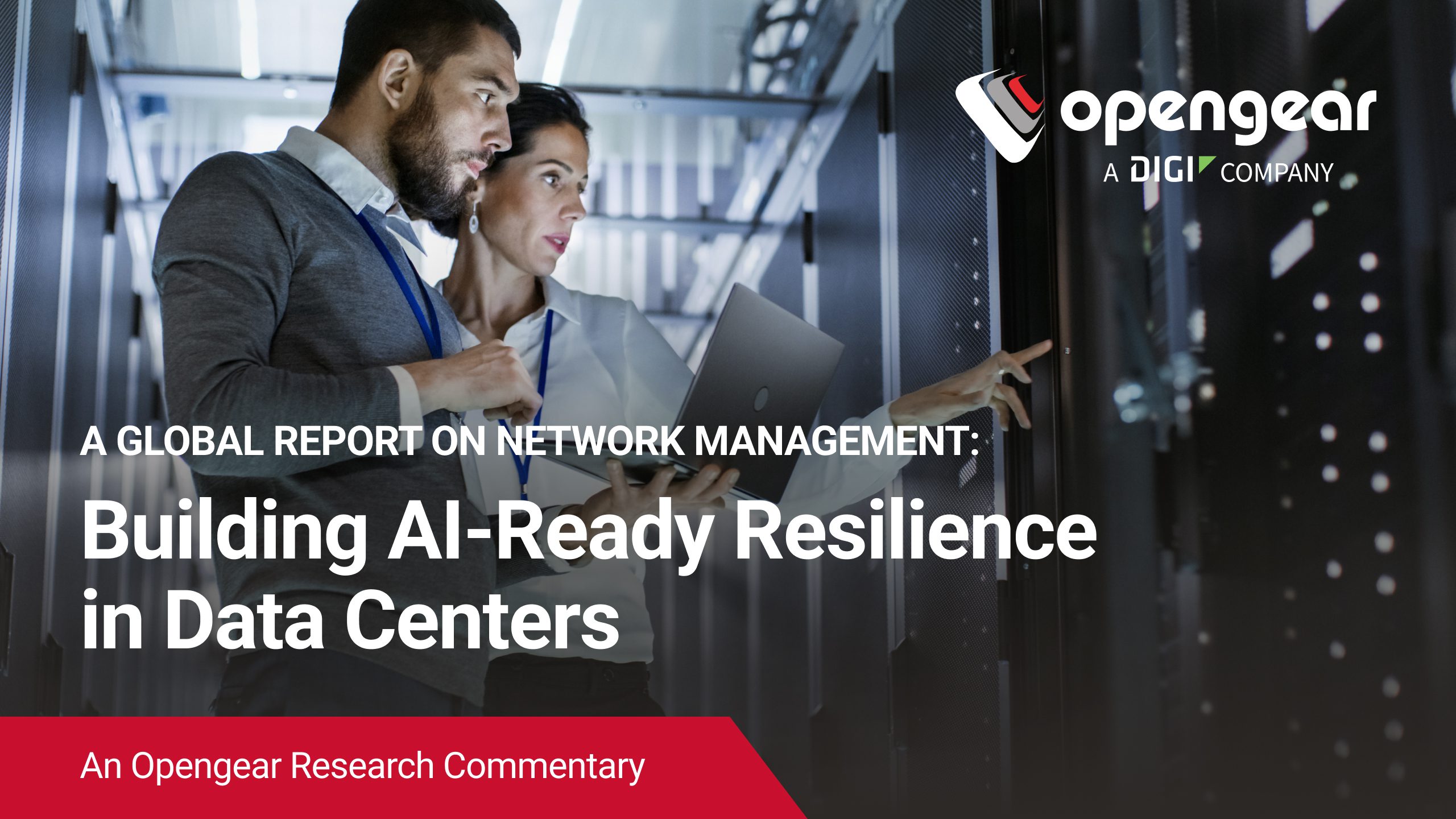
Data centers are the backbone of today’s digital economy. As businesses expand their services and rely more heavily on connected infrastructure, the performance, security, and resilience of networks are mission-critical.
Opengear’s latest research report reveals an urgent reality: network outages are happening more often, causing greater disruption, and costing organizations millions.
This global study surveyed more than 1,000 CIOs, CSOs, and network engineers across the United States, United Kingdom, France, Germany, and Australia to understand how IT leaders are addressing risk, investing in resilience, and adapting to increasingly hybrid and distributed infrastructure.
Here’s what we learned.
84% of IT leaders reported an increase in network outages over the past two years.
The financial impact is significant. Nearly one in three organizations reported losses of between $1 million and $5 million due to outages in the past year. Beyond the money, outages damaged reputations, disrupted operations, and eroded customer trust.
Takeaway: Outages are now regular business risks with major consequences for revenue and brand equity.
The survey revealed both technical failures and human error.
As enterprises manage hybrid IT environments that span centralized data centers, edge locations, and cloud services, the chances of disruption grow and recovery becomes more complex.
Takeaway: Outages often stem from preventable issues, but complexity magnifies their impact.
To reduce these risks, organizations are making targeted investments.
Together, these approaches strengthen infrastructure resilience:
Takeaway: AI, edge, and OOB form a resilient foundation for always-on operations.
Security risks are also growing as networks expand.
In response, IT teams are turning to:
Out of Band management plays a role here as well, providing visibility and control even when the production network is compromised.
Takeaway: Security and resilience are inseparable. Distributed networks demand both.
The findings are clear: outages are increasing, infrastructure is more complex, and the cost of failure is rising.
Forward-looking organizations are responding by:
Patrick Quirk, President and General Manager of Opengear, explains:
“Outages are no longer isolated events. They are happening more often, and the cost is hitting businesses hard. Complexity, aging infrastructure, human error, and cyber-attacks are all part of the problem. As organizations lean more heavily on data centers to power digital transformation, the stakes are higher than ever. An outage is not just downtime. It is lost revenue, lost productivity, and lost trust.”
Opengear’s research confirms what IT leaders already know: resilient infrastructure is no longer optional. It is the foundation of digital business, ensuring uptime, security, and continuity even as networks grow more distributed and complex.
From AI-driven automation that predicts and prevents failures, to edge computing strategies that reduce latency and avoid single points of failure, to secure Out of Band management that provides always-available remote access, the next generation of data center and network infrastructure is being built with resilience at its core.
Resilience is not an afterthought or a bolt-on. It is becoming a design principle that organizations are embedding into every deployment from the start.
Learn more: Download the full research report for complete findings and recommendations.
What causes most data center outages?
Opengear’s research shows the leading causes are device configuration changes (27%) and server hardware failures (26%), followed by power supply issues, cyberattacks, and software upgrades.
How much do network outages cost businesses?
Nearly one in three organizations reported financial losses between $1 million and $5 million in the past year, with additional costs tied to reputational damage and customer trust.
Why are network outages increasing?
Outages are increasing because IT environments are more complex and distributed, spanning data centers, edge sites, and cloud services, which creates more opportunities for failure.
What is Out of Band (OOB) management?
Opengear’s Out of Band management, also known as Smart Out of Band, is a secure, independent management channel that gives IT teams remote access and control of infrastructure even when the primary network is down.
How does Out of Band management improve resilience?
OOB management ensures uptime by allowing IT teams to diagnose, access, and restore systems remotely, reducing downtime during outages or cyber incidents.
How do AI and edge computing help prevent outages?
AI and machine learning predict and prevent failures through automation, while edge computing reduces latency and avoids single points of failure by distributing workloads closer to users.
Why is security a growing concern for data centers?
As organizations adopt cloud and edge strategies, the attack surface expands. Risks such as data breaches, insecure APIs, and compliance challenges require solutions like OOB management, which adds secure visibility and control even during an attack.
AI workloads don’t pause, and neither can the networks behind them. As advanced AI reshapes data center infrastructure, it brings new demands for uptime, access, scalability, and security. Opengear’s Network Resilience Platform keeps your infrastructure moving at machine speed, always on, always in control.
Demand for AI-capable data center capacity is projected to grow at approximately 33% annually through 2030, with nearly 70% of data center use expected to support advanced AI workloads by then. That scale of growth is unmatched in traditional environments.
To meet that capacity, organizations must evolve beyond traditional data center design. Legacy networking can’t support the extreme bandwidth and low-latency needs of AI deployments. In fact, AI workloads are already reshaping intra-data-center communications, aggressively increasing fiber and network requirements.
A recent survey shows 43% of new data center facilities will be dedicated to AI workloads, with many decision-makers expecting a 6x increase in Data Center Interconnect bandwidth over the next two to three years.
The result? A new infrastructure imperative: networks that are always available, secure, and designed for distributed and edge-scale environments, not just centralized facilities.
What does “always-on” mean in practice?
Smart Out of Band™ (OOB) solutions and Lighthouse® centralized orchestration provide exactly that. Built to maintain access even when primary networks are down, they deliver continuity and control across distributed AI infrastructure.
Lighthouse enhances efficiency with Zero Touch Provisioning and broader visibility, making it easy to manage GPU servers, accelerators, console servers, and remote gateways in a single pane of glass.
The core value is clear. AI environments include new infrastructure layers, and operational issues can’t wait for manual intervention. Instead, they demand automation and proactive resolution.
Infrastructure failure in an AI environment is more than just slow service. Failure can halt training, delay inference, and block time-sensitive workflows entirely. Opengear’s purpose-built support and automation ecosystem offers:
In complex environments (such as edge AI deployments, where remote sites run inference locally) OOB access and uptime assurance become operational requirements, not optional extras.
Recent research by Opengear indicates 57% of network engineers expect AI-related investment to rise by more than 25% over the next two to three years. (And 49% of CIOs/CSOs agree with this assessment.) Yet 70% of engineers feel these plans may still fall short of business needs, highlighting a gap between expectations and preparedness.
Large-scale infrastructure shifts, from hyperscalers investing billions to global rollouts of GPU-capable data centers, underscore the speed at which networks must evolve.
Opengear’s platform supports always-on environments with tools designed for AI-scale complexity:
AI workloads magnify every weakness in the network. With nonstop demand and distributed deployment models, even a momentary outage can disrupt training, stall inference pipelines, or break SLAs.
That’s why resilience can’t be an afterthought. Opengear’s Network Resilience Platform builds readiness into every layer: from Smart Out of Band access and Failover to Cellular, to centralized orchestration with Lighthouse. These capabilities ensure control and continuity across both core and edge environments.
They’re not just for emergencies. They’re essential for daily operations—automating response, simplifying remote management, and giving network teams the visibility they need to stay ahead of issues.
Because AI won’t wait. And neither should your infrastructure.
For more information on how Opengear can help ensure network resilience, schedule a demo.